
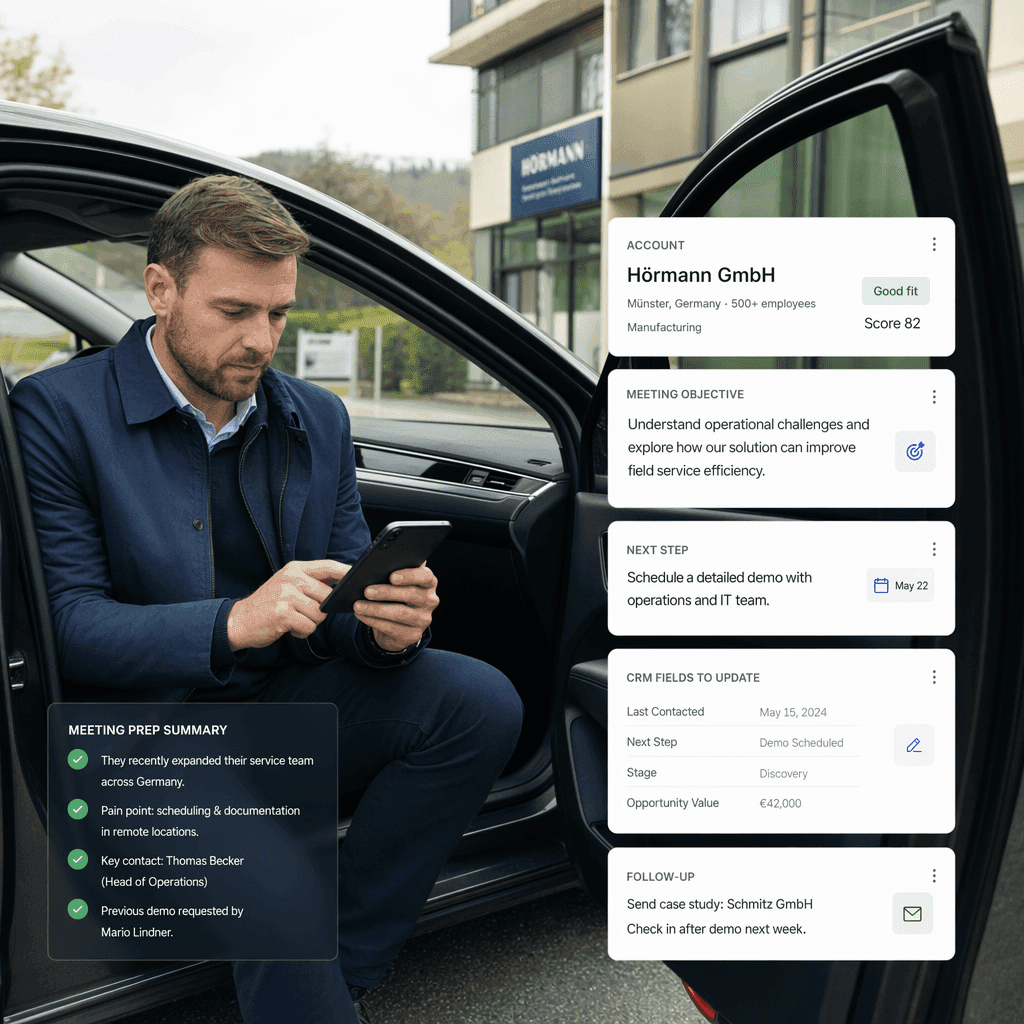
Field sales meeting preparation is not about spending an hour building a perfect briefing document.
It is about walking into the customer visit with enough context to ask sharper questions, spot real buying signals, and leave with a clear next step.
For field reps, the hard part is not knowing that preparation matters. The hard part is doing it between the last visit, the next drive, a CRM that is not fully up to date, and a manager asking for pipeline reality.
This checklist is built for that reality.
The 10-Minute Field Sales Meeting Prep Checklist
Before every customer visit, a rep should be able to answer five questions:
- Who am I meeting?
- What has happened with this account recently?
- What is the goal of this visit?
- What do I need to learn?
- What should happen after the meeting?
If the answer to any of those is vague, the visit becomes harder to control. The conversation may still be friendly, but it is less likely to move the deal forward.
1. Review the Account Context
Start with the account, not the meeting.
Look for:
- Company size, segment, and location
- Current products or services used
- Open opportunities
- Recent orders, renewals, or support issues
- Previous objections
- Last meeting notes
- Key contacts and decision-makers
The goal is not to memorize the whole CRM record. The goal is to avoid asking questions the customer already answered last time.
A useful prep summary sounds like this:
“This account renewed six months ago. Last visit focused on implementation delays. Main stakeholder is Camille in operations. Next opportunity is expansion to the Lyon site. The risk is budget timing.”
That is enough to walk in with direction.
2. Check the Last Interaction
The last interaction is usually the most important prep material.
Before the visit, review:
- What the customer said last time
- What you promised to send
- What objections were raised
- What next step was agreed
- Whether that next step actually happened
This is where many field teams lose credibility. A rep says, “I’ll send that by Friday,” then forgets because the note stayed in a car, a notebook, or a half-written CRM update.
Good preparation starts by closing the loop from the previous visit.
3. Define One Meeting Objective
Every field sales meeting needs one main objective.
Examples:
- Confirm the buying process
- Understand why the deal stalled
- Identify the technical decision-maker
- Reopen a dormant account
- Get agreement on a pilot
- Confirm renewal risk
- Validate the next order quantity
Avoid vague objectives like “check in” or “build relationship.” Those may be part of the visit, but they are not enough to guide the conversation.
A better version is:
“Understand whether the customer is ready to expand to two more sites this quarter, and identify the blocker if not.”
That gives the rep a clear path.
4. Prepare Three Questions
Do not prepare a script. Prepare questions.
For most field visits, three good questions are enough:
- What changed since our last conversation?
- What needs to happen before you can move forward?
- Who else will be involved in the decision?
Then adapt based on the account.
For a renewal visit:
- “What has worked well since the last renewal?”
- “Where are you still losing time?”
- “What would make renewal hard this year?”
For an expansion visit:
- “Which team would benefit next?”
- “What would need to be proven first?”
- “Who owns the budget for the next rollout?”
For a stalled opportunity:
- “What made this less urgent?”
- “Is the problem still active?”
- “What would make it worth revisiting now?”
Good prep does not make the meeting robotic. It gives the rep better starting points.
5. Know What You Need to Capture
A field meeting is only useful if the important details survive after the visit.
Before the meeting, decide what you need to capture:
- Customer pain
- Buying timeline
- Budget signal
- Decision process
- Competitors mentioned
- Objections
- Promised follow-up
- Next meeting date
- CRM fields that need updating
- Manager-visible risk or upside
This matters because memory is unreliable after a day of visits. By 6 p.m., three conversations start blending together.
Reps should not need to type a perfect report in the parking lot. But they should know what information matters before the meeting starts.
6. Plan the Follow-Up Before the Meeting Ends
A strong follow-up starts during the meeting, not after it.
Before you leave, confirm:
- What was agreed
- Who owns the next action
- When it will happen
- What you will send
- What the customer should expect next
A clean closing line:
“I’ll send a recap with the pricing scenario we discussed, and I’ll include the rollout option for the second site. Does Thursday still work for the next call?”
That sentence gives you the follow-up email, the CRM task, and the opportunity next step.
7. Update the CRM While the Visit Is Fresh
The best time to update the CRM is right after the meeting.
Not at the end of the day. Not Friday. Not when the manager asks.
Right after the visit, the rep still remembers:
- The customer’s exact wording
- The real objection
- The emotional tone
- The next step
- The risk that was implied but not said directly
This is where voice capture helps field teams. Instead of typing in the car, a rep can record a short recap:
“Met with Camille at Lyon site. Main issue is still onboarding time. They are interested in expanding to the second site, but budget approval sits with finance. Send comparison by Thursday. Next step: schedule call with Camille and finance lead next week. Opportunity stage should stay discovery, but close date may move to September.”
A good voice-to-CRM workflow turns that into structured CRM fields, a follow-up draft, and manager-visible pipeline context.
Field Sales Meeting Prep Template
Use this before each visit:
Account context
- Account:
- Main contact:
- Other stakeholders:
- Current opportunity:
- Last interaction:
- Open risks:
Meeting objective
- Main goal:
- Secondary goal:
- What would make this visit successful?
Questions to ask
- Question 1:
- Question 2:
- Question 3:
Signals to capture
- Pain:
- Timeline:
- Budget:
- Decision process:
- Objection:
- Competitor:
- Next step:
After the visit
- CRM fields to update:
- Follow-up to send:
- Task to create:
- Manager note:
- Next meeting date:
What Managers Should Look For
For managers, meeting preparation is not about policing reps.
It is about making the field motion visible.
A manager should be able to see:
- Which meetings have clear objectives
- Which accounts have no recent notes
- Which opportunities have weak next steps
- Which reps are consistently capturing useful customer signal
- Which deals need coaching before the next visit
The point is not more admin. The point is better pipeline data.
If CRM notes are late, vague, or missing, managers start forecasting from opinions. If meeting prep, voice capture, and CRM updates happen in one flow, the pipeline becomes easier to trust.
How Y Fits Into This Workflow
Y is built around the way field reps actually work.
Before a visit, Y helps reps prepare with the context they need. After the visit, reps can capture what happened by voice. Y turns that into CRM updates, follow-up drafts, and clearer pipeline data for managers.
The rep does not need to become a CRM admin. The manager does not need to chase every update. The business gets cleaner customer data because the workflow happens when the information is still fresh.
That is the practical version of AI for field sales: not more dashboards, not more generic summaries, but better execution before and after every customer visit.
FAQ
What is field sales meeting preparation? Field sales meeting preparation is the process of reviewing account context, setting a meeting objective, preparing key questions, and deciding what information needs to be captured before a customer visit.
How long should field sales meeting prep take? For most visits, 10 minutes is enough if the CRM data is current and the rep has a clear summary of the account, last interaction, opportunity, and next step.
What should a field rep do after the meeting? Right after the visit, the rep should capture the customer’s key points, update the CRM, create any follow-up tasks, and send a recap while the conversation is still fresh.
Why do field sales teams struggle with CRM updates? Field reps often work between visits, from cars, customer sites, and mobile devices. Desktop-style CRM workflows create friction, so notes are delayed or skipped.
How can AI help with field sales meeting preparation? AI can summarize account context before the visit, capture post-meeting voice notes, structure CRM updates, draft follow-up emails, and surface useful pipeline signals for managers.
Related articles

Field Sales AI Guide: Workflows, Evaluation, and Limits
A practical guide to using field sales AI before and after customer visits, evaluating accuracy, setting human-review limits, and running a 14-day pilot.

AI Meeting Notes for Field Sales Reps: What Matters
A practical guide to AI meeting notes for field sales reps: what to capture after visits, how to update CRM fields, and where generic note-takers fall short.

Field Sales Coaching: Use Visit Notes to Coach Better
A practical field sales coaching guide for turning post-visit notes, CRM updates, objections, and follow-up promises into better manager one-to-ones.