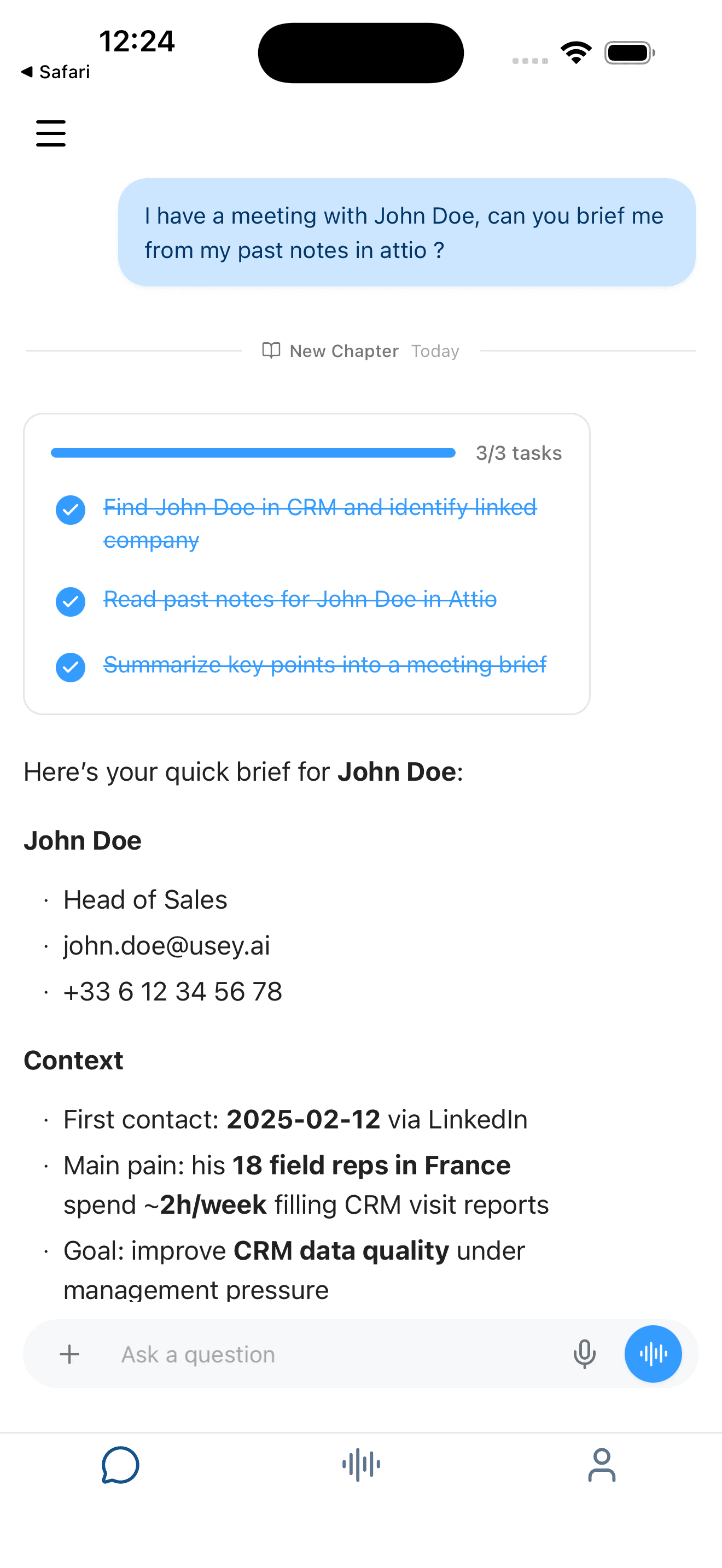
Field sales meeting preparation, ready before the next customer door.

Y makes field sales meeting preparation practical by turning the account context available to your team into a focused pre-meeting brief. Y brings together recent CRM activity, open commitments, and useful talking points so the rep can prepare without searching every system.

Y field sales workflow

The useful context exists, but it is scattered.

The previous outcome may be in the CRM, a promise in email, the agenda in the calendar, and an overdue task in another view. A field rep rarely has time to reconstruct that history in a car park. Y narrows the available information to what can change the next conversation, while keeping the source systems authoritative.

Inputs from connected sales context

A preparation workflow can use the relevant account and opportunity record, recent meeting notes, open tasks, and calendar details. Email context can be included when it is connected and authorized; unavailable sources remain unavailable rather than guessed.

A concise customer history

Y surfaces recent changes, decisions, objections, stakeholders, and previous outcomes instead of reproducing the entire CRM timeline. The rep sees enough history to continue the relationship without rereading every activity.

Commitments and unanswered questions

The brief separates what your team promised, what the customer promised, and what remains unresolved. Dates, owners, and overdue items make it easier to address a missed follow-up before asking the customer for something new.

An actionable meeting brief

The output combines the likely objective, relevant facts, risks, and suggested points to confirm. It supports the rep’s judgment; it does not script the conversation or pretend that old CRM data is current customer truth.


How field sales meeting preparation works

A repeatable brief starts with the meeting and account, then filters the available context for the rep’s immediate goal.

1

Identify the meeting and account

Use the scheduled event or select the relevant customer and opportunity. Confirm uncertain matches, especially when companies have similar names or one meeting involves several accounts.

2

Collect the authorized context

Y retrieves the information available through the connected CRM, calendar, tasks, notes, and other approved sources. Access follows the permissions and configuration established by your organization.

3

Prioritize what matters now

Y summarizes recent events, commitments, risks, and gaps around the meeting objective. Older or repetitive details should stay in the source system unless they materially affect the conversation.

4

Review and prepare your approach

The rep checks dates and sensitive facts, decides which questions to ask, and adjusts the objective using personal knowledge of the account. The brief is a starting point for judgment, not a substitute for it.

What makes a useful pre-meeting brief

Evaluate preparation on relevance, source clarity, and the decisions it helps a rep make before the visit.

Relevance over volume

A good brief highlights the few facts that change the meeting: last outcome, current objective, open commitment, key stakeholder, risk, and next decision. More copied CRM text does not mean better preparation.

Freshness and source awareness

Check whether the rep can recognize where the context came from and notice when it may be stale. A brief should not present an old forecast date or an unverified note as a newly confirmed fact.

Actionable preparation

After reading, the rep should know what to acknowledge, what to clarify, and what outcome to pursue. Test the brief against real meetings and remove information that never changes the rep’s approach.

Common questions

Is the meeting brief a full CRM export?

No. Y is designed to produce a focused view of the recent information most useful for the visit. The CRM and other connected tools remain the place to inspect the complete history when deeper research is needed.

Which data sources can be used?

The available sources depend on the systems your organization connects and authorizes. A typical workflow may include CRM records, meeting notes, tasks, and calendar context, with email or other sources only when the relevant integration and permissions are in place.

What if the CRM data is incomplete or outdated?

The brief can only work from context that is available. Reps should verify important facts and use the meeting to correct gaps. Y does not turn a stale close date or an unsupported assumption into confirmed customer information.

Does an AI brief replace the rep’s preparation?

No. It reduces search and synthesis work. The rep still decides the meeting strategy, accounts for relationship nuances, checks sensitive details, and adapts in the room. Y is an assistant within Y, not the account owner.

Prepare a real customer visit with Y

Bring a representative account, meeting objective, and the context your reps currently search. The Y team will show the resulting brief and identify any source or permission limits.

Request a demo