

Field sales coaching usually fails for a simple reason: the manager is coaching from memory, not from the customer visit.
A rep comes back from the field with a few short notes, a vague CRM update, and a follow-up task. The manager hears that the meeting was good, the buyer seemed interested, and the next step is to send something over. That may be enough for a quick status update. It is not enough for useful coaching.
Useful coaching needs evidence from the visit: what the customer said, which stakeholder was missing, which objection slowed the deal, whether the next step has an owner and date, and what the rep should do differently next time.
This is why field sales coaching should start with post-visit notes. Not long transcripts. Not surveillance. Structured visit notes that turn customer conversations into coaching moments, CRM updates, and better follow-up.
Why field sales coaching is harder than desk sales coaching
Inside sales managers can often review call recordings, email threads, meeting transcripts, and activity data from one place. Field sales managers do not always have that luxury.
A field rep may spend the day moving between customer sites, regional stores, clinics, factories, distributors, or partner locations. Some meetings happen in rooms where recording is not appropriate. Some happen around a counter, in a car park, during a site walkthrough, or after a quick operational discussion.
The best context often lives in the rep's head for only a short time after the visit.
That creates three coaching gaps.
First, the manager sees the outcome but not the behavior. The CRM says the opportunity moved to proposal, but it does not show how the rep handled the budget objection or whether the real decision-maker was in the room.
Second, coaching happens too late. By the time the one-to-one meeting arrives, the rep has already visited ten more accounts. The details are weaker, and the coaching becomes generic.
Third, managers spend too much time chasing basic updates. When the CRM is incomplete, the first coaching question becomes "what happened?" instead of "how do we improve the next conversation?"
That is a waste of manager attention.
The coaching problem is also a data problem
Field sales coaching depends on clean field data. If visit notes are late, vague, or disconnected from CRM fields, managers cannot reliably coach the right behavior.
The broader CRM data problem is not small. Validity's 2025 CRM data management research found that 76% of respondents said less than half of their organization's CRM data is accurate and complete. Poor data does not only hurt reporting. It also weakens coaching because managers are working from partial customer reality. Validity report
Sales teams are also under pressure to remove admin from the rep's day. Salesforce reported that sales professionals spend 70% of their time on non-selling tasks, including admin, data entry, and meeting preparation. Asking field reps to write longer coaching notes at the end of the day is not the answer. Salesforce research
The better answer is to capture useful coaching signals immediately after the visit, while the rep still remembers the conversation, and then turn those signals into structured CRM updates and manager context.
SalesRabbit's 2025 Field Sales Report also frames coaching, training, productivity, retention, and AI as active field-sales concerns. That matters because coaching is no longer just a weekly conversation; it is becoming part of the daily field workflow. SalesRabbit report
What a coachable visit note should capture
A coachable visit note is not a diary. It is a short record of what changed and where the rep needs help.
After every meaningful customer visit, ask for seven signals.
1. Meeting outcome
What happened in plain language?
A weak note says: "Good meeting. Sending proposal."
A coachable note says: "Operations wants the pilot, but finance was not present. Customer asked for two pricing options by Friday."
The second version gives the manager something to inspect.
2. Buyer intent
Was the customer exploring, evaluating, ready to move, delaying, expanding, or at risk?
Buyer intent matters because managers coach differently depending on the deal state. A rep with an exploring account may need discovery coaching. A rep with an evaluating account may need help with business case, pricing, or stakeholder mapping.
3. Next step quality
A next step is real only when it has an action, owner, and date.
"Follow up next week" is not coachable. "Send revised proposal Friday; Sarah will bring finance to Tuesday's review" is coachable.
This gives the manager a clear signal: the rep either created mutual commitment or left the meeting with a loose task.
4. Objection or blocker
The best coaching often comes from the blocker.
Was the objection about price, timing, integration, procurement, risk, compliance, internal alignment, or urgency? Did the rep answer it well? Did they avoid it? Did they need help?
A manager cannot coach objection handling if the note only says "customer had concerns."
5. Stakeholder map
Who was present, who was absent, and who influences the decision?
Field reps often speak with operational users, local managers, and regional leaders before a budget owner appears. Coaching should help reps multi-thread earlier, especially when the person in the room is not the person who can approve.
6. Follow-up promise
What did the rep promise to send, and by when?
This is both a customer-experience signal and a coaching signal. Generic follow-up creates weak momentum. Specific follow-up shows whether the rep understood the customer's problem.
7. Rep confidence
Ask for a simple confidence score from 1 to 5, plus the reason.
The number is less important than the explanation. "Confidence 3 because operations is engaged but finance is missing" gives the manager a coaching entry point.
A simple field sales coaching loop
Once post-visit notes include those signals, managers can run a lighter and better coaching loop.
Step 1: Capture the visit while it is fresh
The rep records a one- or two-minute voice note after the meeting, before the next appointment. This is the practical moment. The rep still remembers the exact objection, stakeholder reaction, promised follow-up, and risk.
Step 2: Turn the note into structure
The note should become a short summary, suggested CRM updates, next step, follow-up draft, and coaching signal. The manager should not have to read a raw transcript to understand the issue.
Step 3: Review patterns, not isolated anecdotes
One visit note helps with one deal. Ten visit notes reveal a pattern.
Maybe a rep struggles when finance joins. Maybe next steps are often vague. Maybe the rep gets interest from local managers but does not reach the economic buyer. Maybe follow-up is fast but too generic.
Those patterns are the real coaching material.
Step 4: Coach one behavior at a time
Do not turn every visit note into a performance review. Pick one behavior to improve.
Examples:
- Ask for a named next step before leaving the meeting.
- Confirm the decision process instead of assuming it.
- Capture the buyer's exact objection.
- Send follow-up that reflects the customer's words.
- Add the missing stakeholder before the next proposal review.
This keeps coaching practical.
Step 5: Connect coaching back to the CRM
Coaching should improve the system of record, not sit in a separate manager notebook.
If the visit note reveals a risk, the CRM should show the risk. If the close date is unrealistic, it should move. If the next step is weak, the task should be fixed. If the customer requested a proof point, the follow-up should reflect it.
That is how coaching improves pipeline quality instead of becoming another side process.
Example: from raw note to coaching action
Raw voice note:
"Met with Claire at MetroCare. They like the workflow, especially the automatic follow-up, but she said the regional director will need to approve budget. I promised to send a recap and a two-option pilot plan tomorrow. She can invite the regional director next Thursday if we send the numbers first. I did not get a clear success metric. Confidence is 3."
Structured CRM update:
- Outcome: positive evaluation, budget approval missing.
- Next step: send two-option pilot plan tomorrow.
- Customer owner: Claire invites regional director next Thursday.
- Risk: no success metric and budget owner not yet engaged.
- Follow-up: recap plus pilot options.
- Stage: proposal or evaluation, depending on your CRM process.
Coaching action:
The manager should coach the rep on defining the success metric before the regional director meeting. The rep has momentum, but the deal could become price-only if the business case is unclear.
That is useful coaching. It is specific, timely, and tied to the next customer conversation.
What managers should avoid
Field sales coaching breaks when managers use visit notes as compliance checks.
Avoid these patterns:
- Requiring long reports after every minor visit.
- Correcting every sentence in a note.
- Turning voice capture into surveillance.
- Asking reps to duplicate the same information in multiple tools.
- Coaching only on activity volume.
- Waiting until forecast day to inspect deal risk.
The goal is not more reporting. The goal is better coaching from less friction.
How Y fits this workflow
Y helps field sales managers get clearer visibility without chasing every rep for updates.
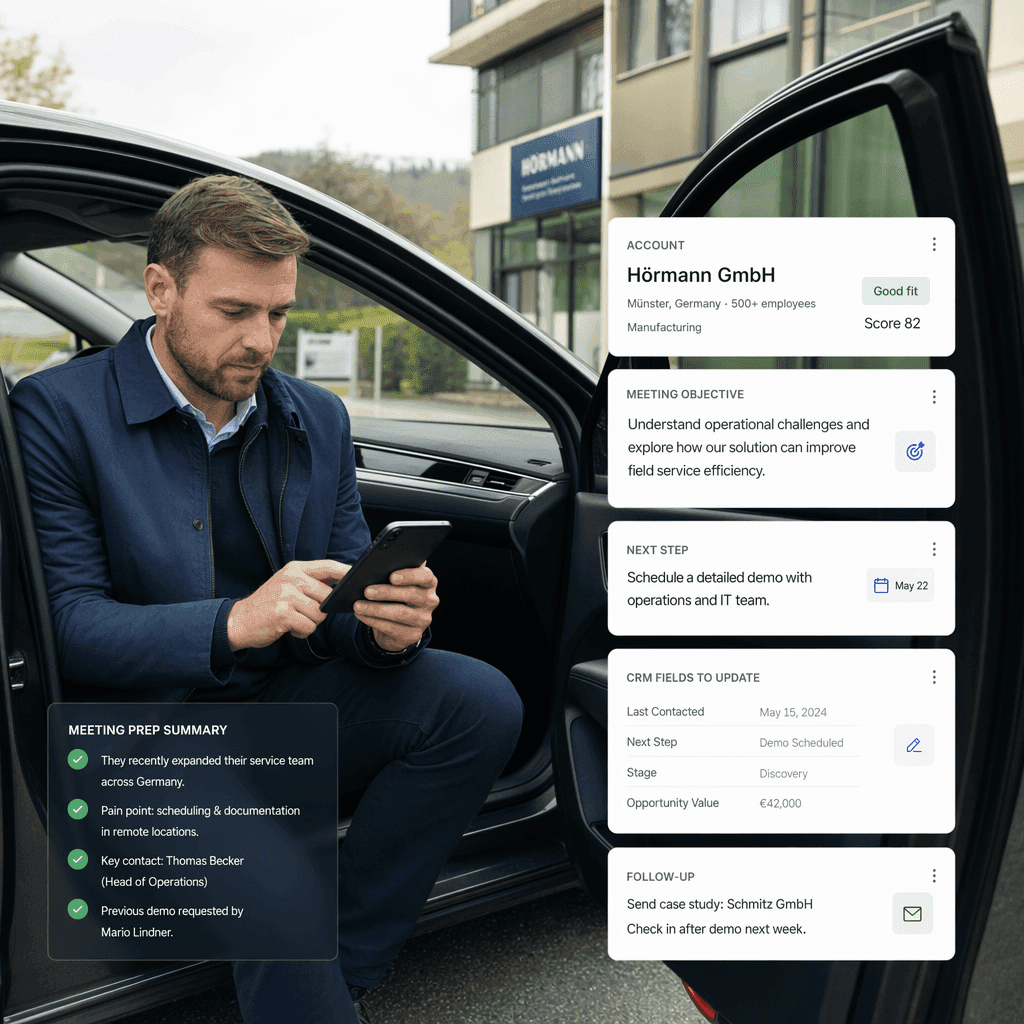
Before a visit, Y helps reps prepare with the customer context they need. After the visit, the rep can capture a short voice recap. Y turns that recap into structured CRM updates, follow-up context, and the signals a manager needs for coaching.
This connects the full workflow: meeting preparation, post-visit voice capture, CRM updates, follow-up, and manager coaching.
It also supports the habits that make field teams more reliable: clearer next steps, faster follow-up, cleaner opportunity data, and coaching tied to real customer conversations.
If your team already uses visit reports, start with the shorter version. Capture the outcome, next step, risk, follow-up, and coaching signal after each important customer visit. You can use the field sales visit report template as the base, then add one manager question: "what should we coach before the next customer conversation?"
For pipeline reviews, connect those notes to trusted pipeline data. For rep productivity, connect them to voice-to-CRM and the demo.
FAQ
What is field sales coaching?
Field sales coaching is the manager process of helping reps improve customer conversations, route execution, follow-up, deal qualification, and CRM discipline based on what happens in the field.
Why should coaching start with visit notes?
Visit notes capture the customer reality closest to the moment it happened. When they include outcome, next step, blocker, stakeholder, follow-up, and rep confidence, managers can coach from evidence instead of memory.
What should managers look for in post-visit notes?
Managers should look for next step quality, missing stakeholders, buyer intent, objections, promised follow-up, deal risk, and any CRM field that should change.
Can AI help with field sales coaching?
AI can help by turning a short post-visit voice note into a structured summary, CRM update, follow-up draft, and coaching signal. The manager still owns the judgment and the coaching conversation.
Related articles

Field Sales Visit Report Template: What to Capture After Every Customer Visit
A practical field sales visit report template for customer visits, CRM updates, follow-up, coaching, and cleaner pipeline data.

Trusted Pipeline Data Starts Right After the Customer Visit
Pipeline data does not become trustworthy in a forecast meeting. It becomes trustworthy minutes after a customer visit, when the rep still remembers the real next step, objection, timeline, and risk.
Field Sales Meeting Preparation Checklist: What to Know Before Every Visit
Better field sales meetings start before the visit. Use this checklist to prepare customer context, set a clear objective, capture the right notes, and turn every visit into cleaner CRM data and stronger follow-up.