

Every decade or so, the interface layer of work changes.
In the 90s, it was the desktop. In the 2000s, email became the operating system of business. In the 2010s, chat tools like Slack and Teams replaced long email threads. Now, in the mid-2020s, something new is emerging: voice as a work interface — and sales teams are going to feel it first.
Here's why voice AI is the most natural next step for sales workflows, and what it means in practice.
Why Sales Workflows Are Uniquely Painful Right Now
Sales, more than almost any other function, is built on conversations. Calls, meetings, demos, negotiations. The actual value-creating activity is human-to-human interaction.
But the infrastructure around those conversations — CRM updates, note-taking, follow-up emails, pipeline management — is built for someone sitting at a desk, typing.
That mismatch creates enormous friction. Sales reps spend 20–30% of their time on administrative tasks that don't generate revenue. They switch between their phone, their car, their laptop, their CRM. Every transition is a context switch. Every context switch is lost momentum and lost information.
The irony: the tool designed to help sales teams (the CRM) has become one of their biggest time sinks.
Why Voice Is the Natural Fix
Think about what happens immediately after a sales meeting.
The rep walks out with a clear picture in their head: what the prospect cares about, what the blockers are, what the next step should be, what to say in the follow-up email. All of that information is right there, fully accessible — for about 15 minutes.
Then it starts to fade.
The most natural way to capture that information isn't to open a laptop and type in a CRM form. It's to talk. To debrief out loud, the way you would with a colleague. "We talked about X, they're concerned about Y, next step is Z, here's what I want to say in the follow-up."
Voice AI makes that possible at scale. You speak. The AI structures what you said, maps it to CRM fields, and generates the written outputs — notes, tasks, follow-up email — automatically.
What's Actually Changed Technologically
This wasn't viable three years ago. Two things have changed:
1. Speech-to-text has reached human-level accuracy. Modern transcription models handle accents, industry jargon, and natural speech patterns reliably. A rep can speak naturally — "so the guy at procurement, Thomas, said budget approval needs to go through the CFO before end of Q2" — and the AI understands both the content and the CRM-relevant structure.
2. LLMs can now reason over messy, unstructured input. Early AI tools needed clean, structured input to produce useful output. Today's LLMs can take a rambling 2-minute voice memo and extract: the decision maker, the pain point, the budget indicator, the next step, and the appropriate tone for the follow-up email. Accurately.
The combination of these two capabilities makes voice-first CRM updates not just possible, but genuinely better than typing.
What This Looks Like in Practice
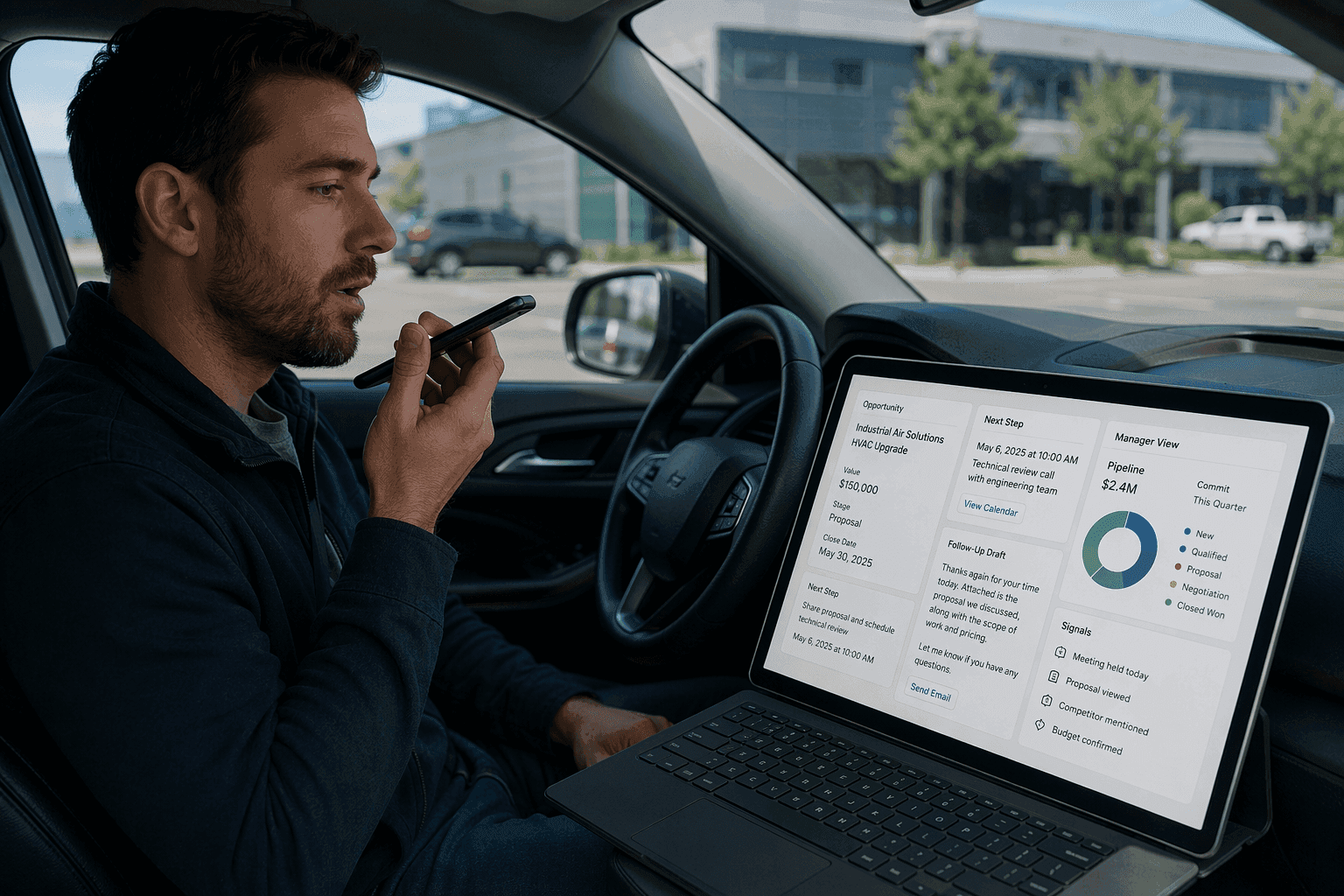
A field rep finishes a meeting. Before starting the car, they open Y and talk for 90 seconds:
"Meeting with Sarah at MedVision, Head of Sales Ops. They're on Salesforce, team of 12 reps. Main pain: reps not updating CRM after field visits, manager has no visibility. Budget owner is the VP Sales, Sarah can influence but not decide. She asked for a pilot with 3 reps next month. I'll send her the onboarding info tonight and propose a 30-day pilot structure."
Y produces:
- ✅ CRM updated: contact, company, deal stage, next step, and close date
- ✅ Meeting notes structured and logged
- ✅ Follow-up email drafted and ready to send
Total time: under 2 minutes. Versus 15–20 minutes of manual work.
The Broader Shift
Voice AI for sales isn't just a productivity tool. It's an interface shift — the same way email changed how salespeople communicated with prospects, and CRM changed how they tracked relationships.
The reps who adapt early will have a structural advantage: cleaner data, faster follow-ups, more time in front of customers. The teams that wait will find themselves defending a manual process that their top performers quietly abandoned two years ago.
We're building Y for the reps who don't want to wait. Join the beta →
Related articles
Field Sales Coaching: Use Visit Notes to Coach Better
A practical field sales coaching guide for turning post-visit notes, CRM updates, objections, and follow-up promises into better manager one-to-ones.

Field Sales Visit Report Template: What to Capture After Every Customer Visit
A practical field sales visit report template for customer visits, CRM updates, follow-up, coaching, and cleaner pipeline data.
Trusted Pipeline Data Starts Right After the Customer Visit
Pipeline data does not become trustworthy in a forecast meeting. It becomes trustworthy minutes after a customer visit, when the rep still remembers the real next step, objection, timeline, and risk.