

You had a great meeting. The prospect was engaged. They asked good questions. You left feeling confident.
And then you wrote a follow-up email that sounded like every other follow-up email they've ever received.
"Great meeting you today! As discussed, I'll send over some information…"
It doesn't convert. And deep down, you know it.
Here's how the best field sales reps write follow-up emails that actually move deals forward — plus a template you can use today.
Why Most Follow-Up Emails Fail
The average post-meeting follow-up email makes three mistakes:
1. It's too generic. It could have been sent to anyone, after any meeting. The prospect doesn't feel seen or understood.
2. It summarizes instead of advances. A recap of what was discussed is fine, but it doesn't create momentum. The email needs to do something — answer a concern, confirm a commitment, or make the next step inevitable.
3. It's written too late. Most reps draft their follow-up emails hours after the meeting, sometimes the next day. The precision and energy of the conversation is gone. The email feels flat.
The Anatomy of a Follow-Up Email That Converts
A great post-meeting follow-up has five components:
1. A personal hook (1 sentence)
Reference something specific from the conversation — not the agenda, but the person. A comment they made, a concern they raised, a goal they mentioned. This signals: I was actually listening.
2. The core insight you shared (2–3 sentences)
Restate the key value proposition in the context of their specific situation. Not your pitch deck. Their problem, your solution, in their language.
3. The main concern, addressed directly (2–3 sentences)
Every prospect has an objection. Most follow-up emails pretend it didn't come up. Name it, and address it briefly. This builds trust and shows you're not dodging.
4. The next step, crystal clear (1–2 sentences)
Don't end with "let me know if you have any questions." Propose a specific next step with a specific timeframe. Make it easy to say yes.
5. One piece of value (optional but powerful)
A relevant article, a case study, a benchmark, or a short piece of data that reinforces your point. Something that gives them a reason to open the email even if they weren't going to reply.
The Template
Subject: [First name] — following up on [specific topic from your meeting]
Hi [First name],
Really enjoyed our conversation today — especially what you said about [specific comment or challenge they mentioned]. It stuck with me.
Based on what you shared, [restate their core problem in their words]. What we've seen with similar teams is [your solution, framed around their context, in 1–2 sentences].
I know [main objection they raised] was a concern — [brief, honest response. Don't oversell. Acknowledge the real challenge and explain why you're confident anyway].
Next step: I'd suggest [specific action, e.g., "a 30-minute call with your VP Sales to walk through the pilot structure"]. Does [specific day/time] work for you?
I'm also attaching [one piece of value — case study, data point, relevant article] that I think you'll find relevant given what we discussed.
Looking forward to it,
[Your name]
The Pro Move: Write It Before You Forget
The best time to write a follow-up email is in the 10 minutes immediately after the meeting. Not because you have more time — because you have more precision. The specific things the prospect said, the tone of the conversation, the real concerns behind the objections: all of that is clear right now, and it will be fuzzy by tonight.
Top reps have developed a habit of doing a quick verbal debrief immediately after leaving the meeting — out loud, as if explaining the call to a colleague — and using that to draft the email.
The problem is that doing this manually still takes 10–15 minutes per meeting. For reps with 4–6 meetings a day, that's an hour of writing just for follow-ups.
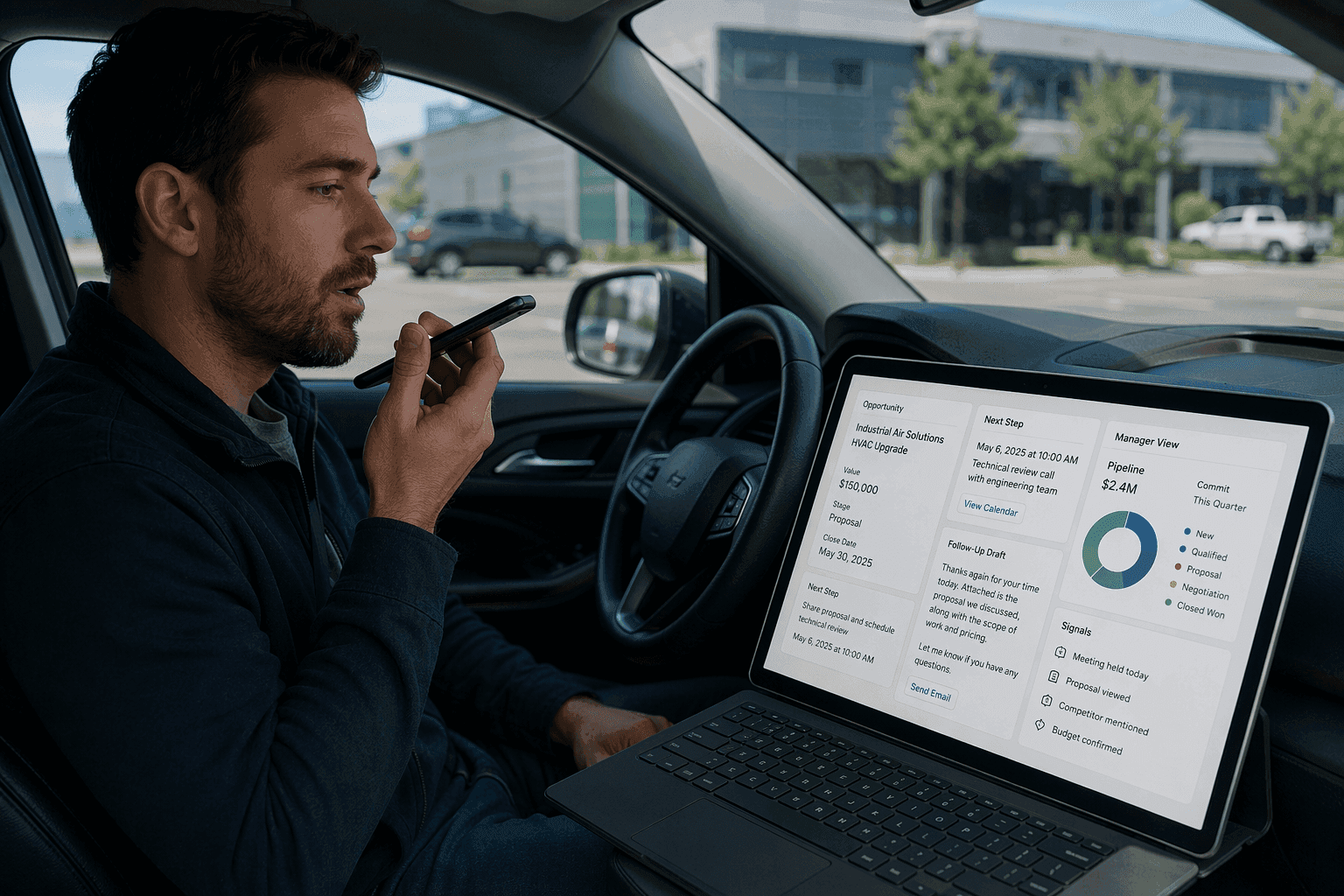
This is one of the core workflows we built Y for. After your meeting, you speak your debrief into Y. It drafts the follow-up email automatically, in the right tone, referencing the right details. You review, adjust if needed, and send.
The template above becomes automatic. The delay disappears. And your follow-up lands while the conversation is still fresh in the prospect's mind — which is exactly when it has the most impact.
👉 Want to automate your post-meeting workflow? Join the Y beta →
Related articles

Field Sales Coaching: Use Visit Notes to Coach Better
A practical field sales coaching guide for turning post-visit notes, CRM updates, objections, and follow-up promises into better manager one-to-ones.

Field Sales Visit Report Template: What to Capture After Every Customer Visit
A practical field sales visit report template for customer visits, CRM updates, follow-up, coaching, and cleaner pipeline data.
Trusted Pipeline Data Starts Right After the Customer Visit
Pipeline data does not become trustworthy in a forecast meeting. It becomes trustworthy minutes after a customer visit, when the rep still remembers the real next step, objection, timeline, and risk.